
Operational Cyber Risk Assurance
Cybersecurity controls do not become defensible because a questionnaire was completed, a service was purchased, or a contract says a capability exists. Leaders need a disciplined way to connect what is required, what is operating, what evidence supports it, what remains unresolved, and who owns the next decision.
Send Manna Too LLC provides Operational Cyber Risk Assurance, enabled by CIRP — Cyber Insurance Readiness Platform, to help organizations connect cybersecurity controls, provider commitments, evidence, remediation, reassessment, and executive decision support.
Why Operational Cyber Risk Assurance matters
- Technology activity does not automatically prove that a required control is operating effectively.
- Provider contracts and service descriptions may not fully establish the evidence needed for executive, customer, audit, or cyber-insurance representations.
- Questionnaires can capture answers without resolving whether those answers are supported by current evidence.
- Remediation can be declared complete without an independent reassessment of whether the condition actually changed.
- Executives need a clear view of what is implemented, evidenced, unresolved, and accountable.
Why Operational Cyber Risk Assurance matters
Organizations often need to align assurance activities with recognized guidance such as the NIST Cybersecurity Framework 2.0 while preserving evidence, accountability, and decision traceability.
The assurance lifecycle
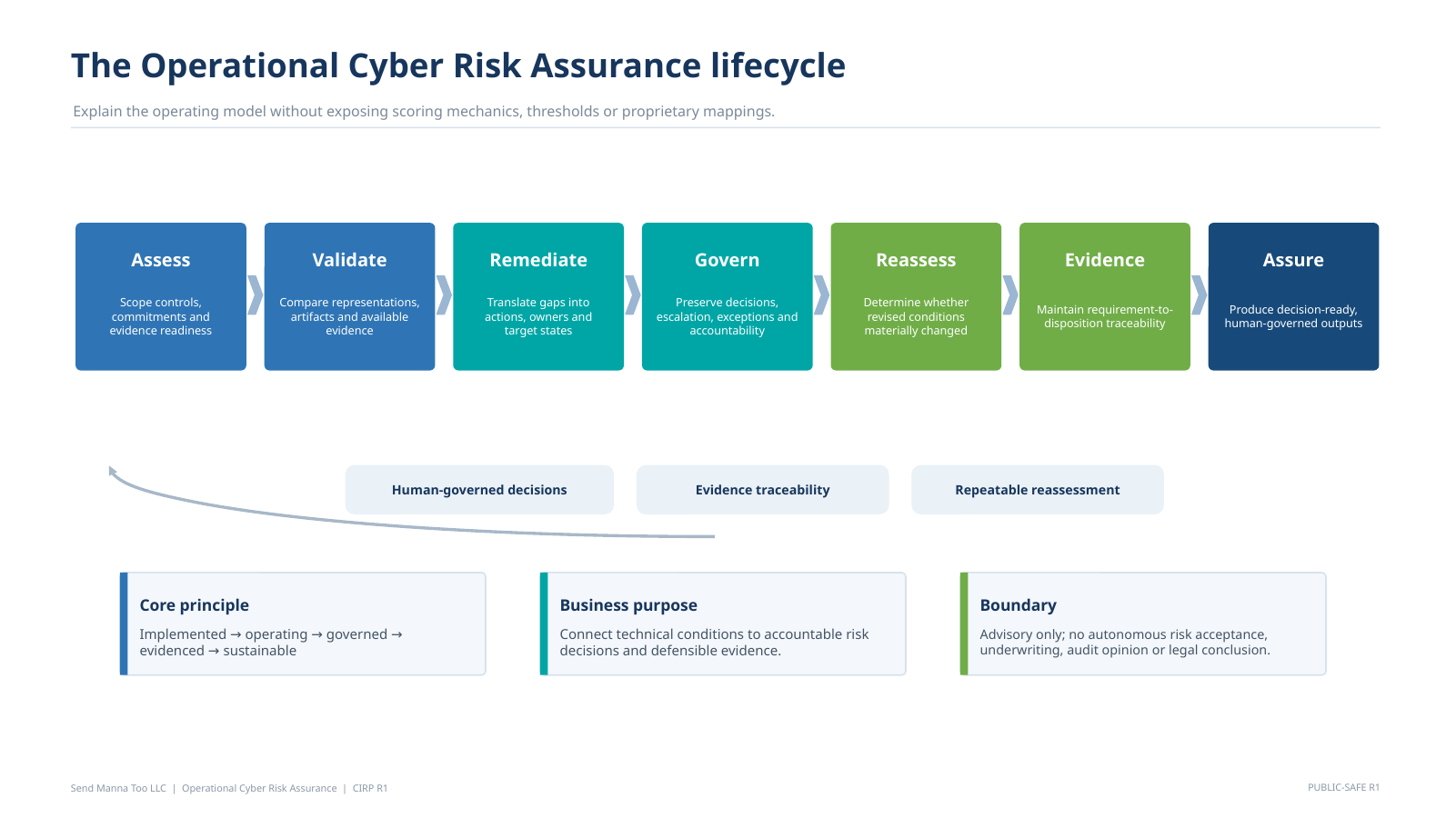
- Assess — scope controls, provider commitments, cyber-insurance expectations, and evidence readiness.
- Validate — compare representations, contract language, control state, and available evidence against defined criteria.
- Remediate — translate gaps into prioritized actions, owners, target states, and evidence expectations.
- Govern — preserve decision rights, escalation, exception handling, and residual-risk accountability.
- Reassess — determine whether revised documents, corrective actions, or new evidence materially changed the condition.
- Evidence — maintain traceability from requirement to control, evidence, finding, remediation, and disposition.
- Assure — produce decision-ready outputs while preserving advisory, audit, legal, and insurance boundaries.
Where CIRP fits
CIRP is the enabling platform inside the assurance workflow. It is not positioned as a replacement for enterprise GRC, TPRM, MSP operations, external cyber-risk monitoring, or insurance platforms. It provides a focused, practitioner-led way to connect provider commitments, evidence, findings, remediation, reassessment, and executive outputs for a defined engagement.
- Works alongside existing GRC and risk systems rather than requiring a platform replacement.
- Uses provider and MSP operating evidence without treating service reports as automatic proof of control effectiveness.
- Supports cyber-insurance readiness without selling, placing, binding, pricing, or underwriting insurance.
- Uses AI only as an assistive capability; authorized humans retain material decision authority.
What clients receive
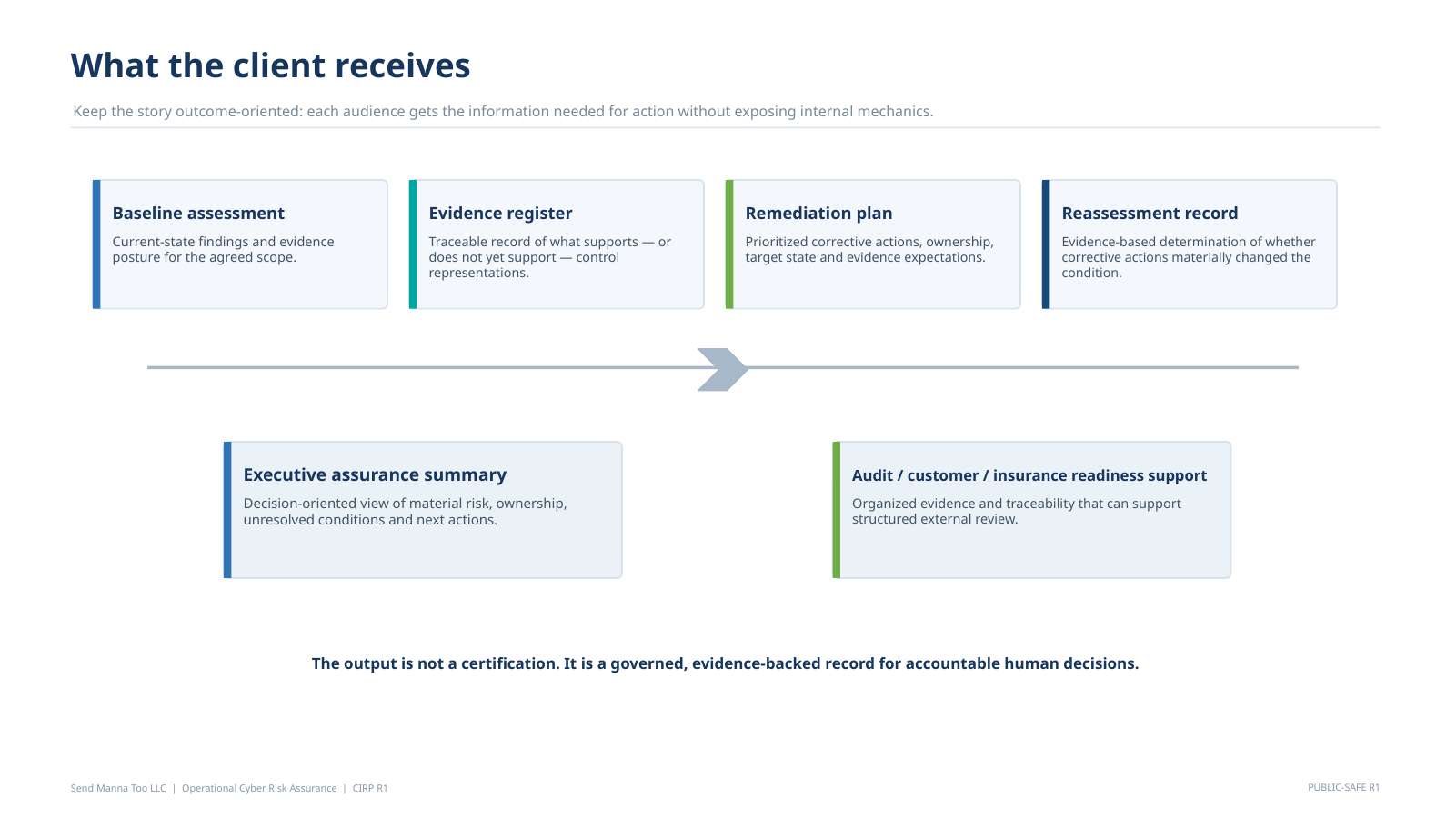
- A defined current-state assessment for the agreed scope.
- An evidence register showing what supports — or does not yet support — material control representations.
- Prioritized findings and remediation ownership.
- A reassessment record for selected corrected conditions.
- An executive assurance summary focused on decisions, unresolved risk, and next actions.
- Structured readiness support for customer, audit, vendor, or cyber-insurance conversations.
Who this is for
Operational Cyber Risk Assurance is designed for organizations that need stronger evidence, clearer ownership, and more disciplined decision support around provider reliance, cyber-insurance readiness, third-party risk, remediation, executive reporting, and recurring assurance.
This approach is especially useful when leadership needs to reconcile provider statements, internal control evidence, remediation commitments, and insurance-related representations before making a material decision. The objective is not to create more documentation; it is to establish a traceable assurance record that shows what was evaluated, what evidence was accepted, what remains unresolved, and who owns the next action.
Controlled R1 boundary
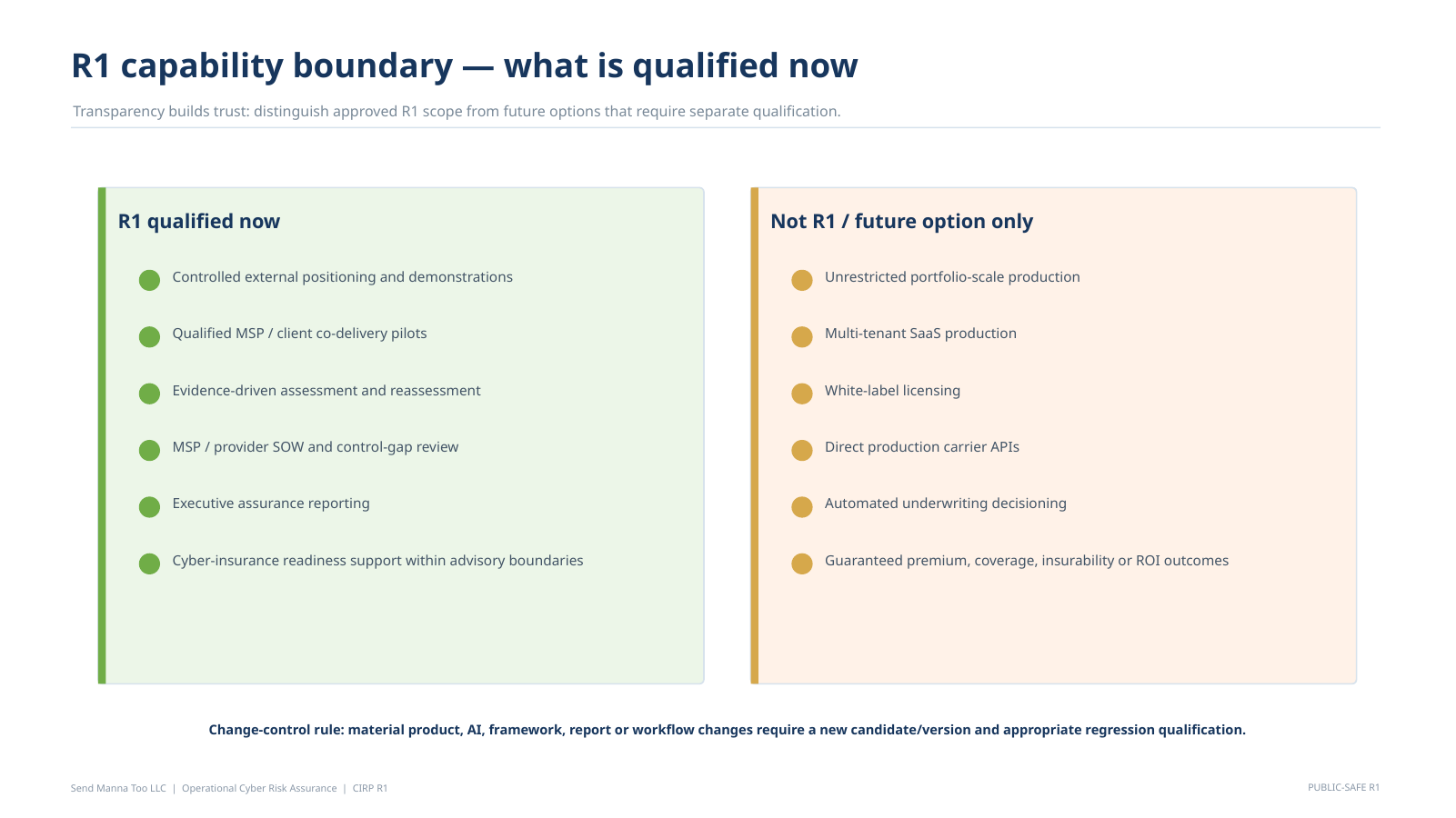
The current R1 capability is approved for controlled market positioning, demonstrations, qualified MSP/client co-delivery pilots, evidence-driven assessment and reassessment, provider/SOW control-gap review, executive assurance reporting, and cyber-insurance readiness support within advisory boundaries.
R1 does not authorize multi-tenant SaaS production, white-label licensing, direct production carrier APIs, automated underwriting, autonomous residual-risk acceptance, legal advice, compliance certification, audit opinions, or guarantees regarding premiums, coverage, insurability, ROI, or claim outcomes.
Call to action
If your organization needs a clearer, evidence-backed way to evaluate provider commitments, control readiness, remediation progress, or cyber-insurance representations, Send Manna Too can help determine the right next step.