
MSP Cyber Risk Assurance Enablement
Managed technology creates value. Clients still need to understand whether managed controls, contractual commitments, operating evidence, and residual responsibilities are strong enough to support executive, customer, audit, and cyber-insurance decisions.
Send Manna Too helps MSPs and MSSPs extend the client conversation from technology operations to Operational Cyber Risk Assurance — without requiring the provider to build a full GRC practice or transfer the client’s business-risk authority.
Why this matters for MSPs
- Clients increasingly ask for evidence that managed controls are implemented, operating, and defensible.
- Traditional service reports can show activity while leaving control applicability, contract language, evidence sufficiency, and shared responsibilities unresolved.
- A structured assurance workflow turns gaps into governed remediation and reassessment opportunities rather than informal disputes.
- The model can strengthen executive-level client relationships while keeping technical operations, assurance, and risk ownership clearly separated.
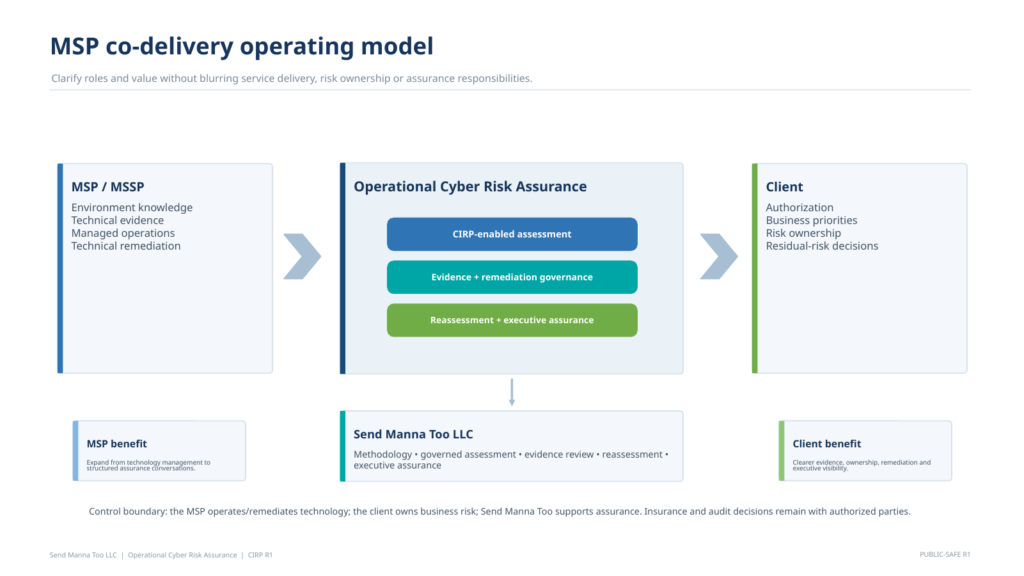
Controlled co-delivery model
- Send Manna Too — methodology, CIRP-enabled assessment, evidence review, governance, reassessment, and executive assurance.
- MSP / MSSP — environment knowledge, service data, technical evidence, and remediation where responsible.
- Client — authorization, business priorities, risk ownership, material decisions, and residual-risk acceptance.
Insurance placement, underwriting, audit conclusions, legal interpretation, and business-risk acceptance remain with the authorized parties responsible for those decisions.
Pilot 001 – prove repeatability and commercial value
- Qualification — confirm sponsor, representative client, operational visibility, data boundaries, and remediation capability.
- Authorization — agree scope, roles, evidence expectations, AI permissions, confidentiality, and commercial terms.
- Baseline — assess scoped controls and provider commitments against available evidence.
- Remediation governance — assign actions, owners, target states, dependencies, and validation criteria.
- Reassessment — determine whether selected corrective actions materially changed the condition.
- Closeout — deliver executive assurance, value/economics evidence, and a GO / GO WITH CONDITIONS / HOLD / STOP decision.
What this is not
- Not an audit of the MSP.
- Not a replacement for the MSP’s operational tools or reporting.
- Not an insurance placement or underwriting service.
- Not a white-label or self-service partner platform in R1.
- Not a promise of premium savings, coverage, insurability, or client selection outcomes.
MSP Cyber Risk Assurance: Common Questions
Is this a GRC replacement?
No. It is a focused assurance engagement that can complement an existing GRC or risk system.
Does AI make risk decisions?
No. AI assists analysis; authorized humans retain material risk, exception, audit, legal, and insurance decision authority.
Will this guarantee cyber-insurance coverage or a better premium?
No. The work supports readiness and evidence discipline. Coverage, pricing, and underwriting decisions remain with authorized insurance parties.
Our MSP already provides reports. Why do we need this?
Operational reports show activity. Assurance asks whether that activity satisfies the required control, whether provider commitments match, and what evidence supports reliance.
Can we just complete the questionnaire?
A questionnaire captures representations. The assurance workflow helps determine which answers are supported, which remain unverified, and which require remediation.
Where MSP Cyber Risk Assurance fits
MSP cyber risk assurance complements the operational tools, reporting, and services MSPs and MSSPs already provide. It focuses on whether managed controls, provider commitments, evidence, remediation, and shared responsibilities are sufficient for a defined reliance or executive decision.
It can work alongside enterprise GRC, third-party risk management, external cyber-risk monitoring, cyber-insurance workflows, and provider reporting without replacing those capabilities. MSP cyber risk assurance adds practitioner-led evidence review, governed findings, remediation ownership, reassessment, and executive assurance while preserving the MSP’s technical responsibilities and the client’s business-risk authority.
The approach can also support alignment with recognized guidance such as the NIST Cybersecurity Framework 2.0 while preserving provider, client, and assurance decision boundaries.
Qualification fit
A strong Pilot 001 candidate has an executive sponsor, a representative client willing to authorize evidence review, sufficient operational visibility, technical cooperation, clear risk ownership, and the ability to remediate material findings.